
What began as an effort to update bibliographies and citations in the By Water and the Spirit study guide became a lengthy project for the Rev. Mark Stamm. His background as a local church pastor, author, professor, and student of sacramental theology made him the perfect person to update the beloved 30-year-old resource.
A timeline of By Water and the Spirit
1988: General Conference forms the Committee to Study Baptism. General Conference also approves the United Methodist Hymnal, which includes a baptismal rite that had been in development since the mid-1970s.
1992: The Committee to Study Baptism brings a report back to General Conference, which is debated and referred for further study. One of the debated issues is whether to delete Confirmation from the church’s practice.
1996: After a second quadrennium of deep study, the Committee to Study Baptism returns to General Conference and their report is adopted into the Book of Resolutions. This report is what the denomination knows as By Water and the Spirit, a United Methodist Understanding of Baptism.
1997: A study guide to help the denomination engage with By Water and the Spirit is published. The General Board of Discipleship commissioned the Rev. Gayle Felton, professor at Duke Divinity School, to craft the study guide.
2004, 2012, 2020/2024: General Conferences renew By Water and the Spirit, a United Methodist Understanding of Baptism, to retain it in the Book of Resolutions, now Resolution 5400.
2026: A revised study guide is published by Upper Room Books, with updated and additional information by the Rev. Mark Stamm, professor emeritus at Perkins School of Theology.
“The world has changed. The conversations, liturgical studies field, and context have changed… but [By Water and the Spirit in the Book of Resolutions] stayed the same,” observes Stamm.
Updating a classic resource
The original study guide includes the full text of the resolution in The UMC’s Book of Resolutions and the interpretation and reflection of the author, the late Rev. Gayle Felton, who was a professor at Duke Divinity School.
“Anytime you talk about baptism and membership in the church, you’re also, as Methodists, talking about conversion and what it means to experience the warm heart,” Stamm shares. “You have the same dilemma that John Wesley seemed to have, that baptism was a beginning, but it wasn’t full conversion, although it’s related.
“It was not simple for Methodists to talk about this. [The 1997 study guide] was an attempt to get this before the whole church… I have great respect for Gayle Felton and the work she did. She was a key voice in developing an understanding of baptism in Methodist tradition. The challenge for me when I was updating [the resource] was to preserve as much of Gayle as I could.”
Stamm retained the original study guide’s structure, made updates where necessary, and added “after thirty years” commentary sections throughout.
Among his updates, Stamm discussed the work of certified lay ministers and refreshed information about clergy orders that have shifted since the mid-1990s, including sacramental authority for deacons. He also addressed changes in church polity.
In addition, he added to timeline charts that track historical divisions in the Christian Church and the formation of The United Methodist Church to help visually explain the heritage of our sacramental beliefs.
Baptism and discipleship
“I think it’s important for people to understand how baptism relates to all of life… One of the things which has developed has been the understanding of baptism in relation to discipleship,” says Stamm. “One of the places this gets ritualized is in services of renewal of the baptismal covenant, where we realize the questions asked at baptism aren’t just for the day of baptism, and not just for the individual being baptized.
“Those questions shape discipleship. We are not just the people who have been baptized. We are a baptismal people.”
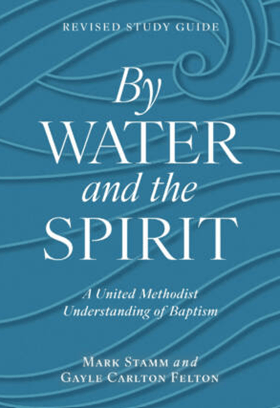
By Water and the Spirit, A Revised Study Guide is crafted for every United Methodist, from Confirmation leaders and Sunday school classes to seminarians and clergy people.
This practical resource explores The United Methodist Church’s official teaching on baptism and aims to equip readers to grow in lifelong discipleship. Its six sections contain the original text of By Water and the Spirit from The United Methodist Book of Resolutions, commentary on the text, and suggestions for how to teach about it.
The study guide is published by Upper Room Books, a ministry of Discipleship Ministries.
As baptized people, our identity shifts and we are inspired and empowered to continue our journey of faith wherever it leads.
“We can ask questions,” Stamm suggests. “What does it look like in our context to resist evil, injustice, and oppression? What does it look like for us to live justly and inclusively?”
Stamm points out that many of our ritual texts reference baptism, such as those shared during weddings and ordination services. He observes, “All of our ministry is rooted in baptism.”
Building awareness and understanding
Stamm expects the revised study guide to increase denominational awareness of the text in the Book of Resolutions and to sharpen knowledge about what we believe as United Methodists.
“I hope that people will bring their best selves and their best insights into this conversation,” Stamm shares. “We live in an ecumenical age. We have a number of ecumenical partners with which we remain in dialogue. Liturgical scholarship happens ecumenically in a lot of ways… It’s important to know what our particular beliefs are.
“Ecumenicity is not about finding a lowest common denominator, it’s about finding things we hold in common and a place where we as the Church have enough confidence in our history and our understanding of things to bring our particular story and insights into a wider conversation.”
Laura Buchanan works at United Methodist Communications. Contact her by email.
This story was published on September 30, 2026.